
Amatuer radio
Amatuer radio
Investment scams are not one thing. They are a set of fraud models built around the same basic task: get the victim to confuse a persuasive story with a real investment process. That story might be about yield, access, technology, insider knowledge, a special relationship, or a temporary market opportunity. The packaging changes with the cycle. The mechanics do not change much. The money is taken, misdirected, or trapped before the victim understands that the main risk was not market volatility but counterparty fraud. Regulators keep stressing the same point in slightly different language: high returns with little risk, pressure to act quickly, secrecy, and difficulty verifying the seller are still the oldest warning signs for a reason.
For traders and investors with basic knowledge, the problem is not just gullibility. It is category error. A person may know how to read a chart, compare fees, or judge a macro story, yet still fail to separate a speculative investment from a fabricated one. Fraudsters exploit that gap. They do not need you to believe something absurd. They only need you to believe something familiar in the wrong place, with the wrong people, under the wrong controls. That is why it helps to sort scams by type. Once you know the main families, the sales pitch gets easier to decode. The accents change, the logic barely does.
This episode will focus on different investment scams. If you want to find good honest investments then I recommend you visit Investing.co.uk.
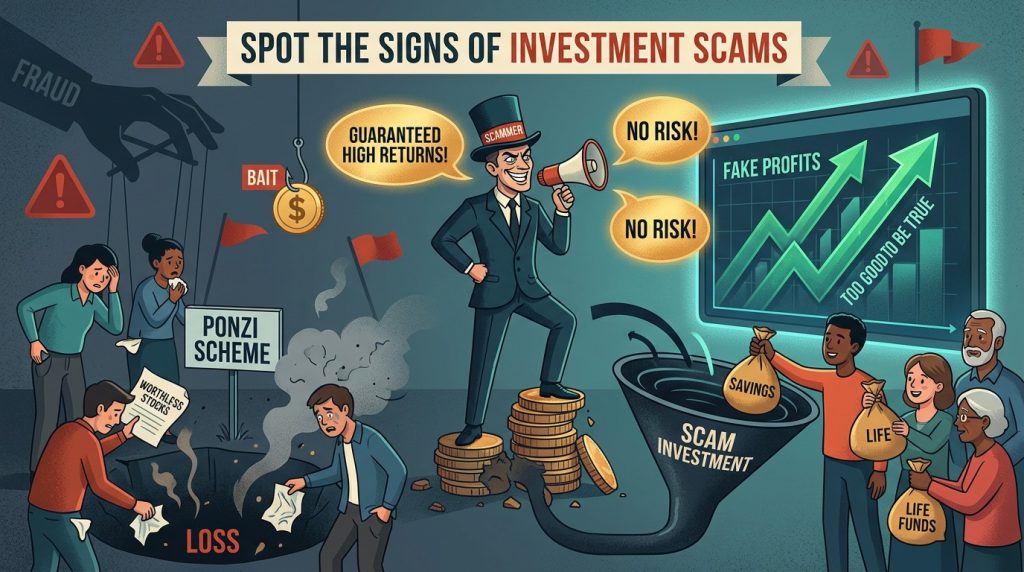
The Ponzi scheme remains the template because it solves a simple problem for a fraudster: how to look profitable before any real profits exist. Earlier investors are paid with money from newer investors, statements show apparent gains, and calm is maintained while fresh money keeps arriving. The SEC has long warned that common features include steady returns regardless of market conditions, unusually consistent performance, vague strategy descriptions, and trouble when investors ask for withdrawals or documentation. Those traits still matter because modern versions often look less theatrical than the stereotype. There may be an app, monthly letters, account dashboards, and a story about arbitrage, private credit, foreign exchange, or digital assets. Same engine, better upholstery.
A close relative is the pyramid structure marketed as investing, education, or a members only wealth club. The economic logic is not actual portfolio return but recruitment and fee flow. These schemes often use investment language because it sounds more respectable than plain old chain recruitment. The participant is told there is a trading desk, a proprietary bot, or a high yield strategy in the background. In practice, the real product is new buyers. That is why the revenue explanation gets foggy the moment you ask where cash flow comes from when recruitment slows. Not a mystery, just arithmetic behaving badly.
Affinity fraud deserves separate attention because the trust mechanism is different. The seller borrows credibility from a shared identity rather than from a financial claim alone. That shared identity may be religious, ethnic, professional, local, military, or social. The pitch works because informal trust lowers formal verification. People assume that someone from their own group would not expose the group to reputational damage. Regulators have been warning about this pattern for years, and it still works because fraud is cheaper when skepticism has already been pre weakened by belonging. Once that social layer is in place, the underlying fraud can be almost any type: Ponzi, private placement fiction, fake fund, or supposed insider access.
Some scams do not start with a fake platform or a fake fund. They start with bad information about a real or thinly traded asset. The classic pump and dump uses promotion to push up interest in a stock, often a microcap or low liquidity name, after which insiders or promoters sell into the buying pressure. The detail that retail investors sometimes miss is that the lie does not have to be large. It only has to be timely enough to create order flow. Paid touting, selective omission, fake newsletters, undisclosed compensation, and fabricated catalysts all play the same role. The fraud is not just the wrong idea. It is the hidden incentive behind the idea.
The SEC continues to warn about solicitors and entities that falsely claim registration, make up credentials, or impersonate real firms. That matters because a scam tip wrapped in fake professional identity lands differently than a random post from an anonymous account. It feels research adjacent. Once the promoter appears licensed, nearby claims become easier to swallow. That is the quiet trick. One false credential can drag several weaker claims through the door behind it.
False information scams have become cheaper to scale because modern distribution is frictionless. The CFTC has warned that most investment fraud begins on social media and that fraudsters use fake profiles, videos, group chats, testimonials, and fake trading websites that display growing balances. FINRA has also warned that AI can be used to create fake audio, altered images, and deceptive video. That means the old research fraud now arrives wearing the face of a broadcaster, analyst, celebrity, or supposed regulator. The content may look polished enough that viewers focus on presentation quality rather than source verification. That is not a small change. It turns credibility into a downloadable asset.
This category also includes impersonation of regulators and law enforcement. The SEC has warned that fraudsters impersonate the agency or its staff through social media and text messages to push stock tips, advance fee fraud, or fake recovery offers. Once that idea is clear, a lot of scattered weirdness in scam messages starts to make sense. The criminal is not always selling an investment directly. Sometimes the criminal is selling permission, urgency, or rescue under a borrowed seal.
A large share of modern investment fraud sits inside a platform shell. The victim is shown a broker site, trading app, exchange portal, or account dashboard that appears to support actual investing. Prices move, charts update, balances rise, and customer support replies quickly while deposits are still coming in. The issue is not whether the front end works. The issue is whether the platform is regulated, whether customer assets are segregated, whether orders are real, and whether withdrawals are controlled by an honest intermediary. The CFTC has warned that fake trading websites can manipulate market data, display growing balances, and even allow small dollar withdrawals to build trust before blocking larger redemptions. That pattern is one of the clearest lines between speculation and fraud. In speculation, the market can beat you. In fraud, the house edits the scoreboard.
Binary options fraud fits here, as do many forex, CFD, and offshore crypto trading scams. The product may be real in some legal settings, but the venue the customer meets through an ad or message is often the problem. A trader may assume they are taking directional risk on a legitimate product when they are actually sending money to an unregistered operator running a dressed up collection funnel. The account statement then becomes marketing, not evidence.
Many platform scams are not exposed at deposit. They are exposed at withdrawal. This is where the operator invents release fees, tax prepayments, insurance charges, minimum turnover conditions, bonus clawbacks, or extra identity requirements that somehow appear only when money is leaving rather than entering. At first glance this can look like compliance gone clumsy. Usually it is simpler than that. The scam requires constant reinterpretation of the rules to stop cash from exiting. Investors often get caught here because they treat the problem as service friction instead of as a control failure. By the time they recognize the pattern, more money has already been sent to “unlock” funds that were never actually free to leave.
One of the ugliest categories is relationship based investment fraud, often called a romance or financial grooming scam. The CFTC describes relationship investment scams as a type of romance fraud that often begins on dating apps, social media, messaging apps, or even wrong number texts. The scammer uses fake profiles, images, videos, and voices to appear trustworthy and professional, then introduces an investment idea only after rapport has formed. This is not a side niche anymore. Regulators have been treating it as a major channel because the trust architecture is strong and the victim often arrives at the platform feeling personally guided rather than sold to.
The reason this category matters for traders is that some victims do have market knowledge. They are not persuaded by romance alone. They are persuaded by a combination of emotional trust and plausible market talk. The scammer may discuss chart setups, volatility, or crypto themes just well enough to sound legitimate, then guide the victim to a fake platform. By the time the account balance begins its miraculous rise, the victim has already outsourced doubt to the relationship.
Recovery scams target people after an initial loss. A fake investigator, regulator, attorney, or tracing service claims it can recover stolen funds for a fee. The SEC has warned that imposters may pose as the agency or its staff for exactly this purpose. That makes recovery fraud especially cruel because the victim is approached at the point of maximum stress and lowest confidence. The scam is also efficient. Anyone who has already sent money to one fraud is statistically easier to target again.
Phishing and account takeover often overlap with investment scams rather than standing apart from them. The FTC warns that scammers use email and text messages to trick people into giving up personal and financial information. In practice, that stolen information can be used to access brokerage accounts, reset credentials, impersonate the investor, or build a more persuasive investment approach later. This is where old fraud and cybercrime stop pretending to be separate categories. They have been dating for years.
The usual answer is greed. That answer is lazy. A better answer is that investment scams copy enough of real market behavior to pass the first screen. Returns can be high in real markets. Opportunities can be time sensitive. Good ideas do spread through networks. New products do emerge before everyone understands them. Fraud lives in that overlap. The trader is not always tricked by fantasy. The trader is often tricked by familiarity placed in the wrong institutional setting.
Pressure is another factor. The FTC warns that scammers use high pressure sales tactics and discourage people from taking time to research. That pressure may be obvious, but it can also be social, procedural, or emotional. A fast moving chat group, a “limited allocation,” a requirement to act before a market open, or a helpful account manager who keeps calling can create the same effect without sounding like a boiler room. By the time the victim slows down enough to verify the counterparty, the money is gone or trapped.
The cleanest distinction is this: a bad trade can happen at a good firm, and a promising trade can happen at a bad firm. Traders spend a lot of time on the first problem and not enough on the second. Fraud prevention starts with the second one. Verify the entity, the registration status, the custody arrangement, the payment route, and the withdrawal terms before arguing about the chart. The chart can wait. The bank transfer usually cannot.
Different types of investment scams use different stories, but they tend to share the same operating logic. They compress trust, blur verification, and move the victim from curiosity to payment before proper checks occur. Some sell fake yield. Some sell fake access. Some sell fake love, fake rescue, or fake authority. The fix is not cynicism about every investment. It is discipline about counterparties. Markets can be risky without being fraudulent. Fraud begins where verification ends.