
Amatuer radio
Amatuer radio
Swing trading is not a scam. It is a trading style. The problem is that “swing trading” is a very useful phrase for people who want to sell things that are either worthless, manipulated, or outright fake. It sounds disciplined enough to attract investors who dislike day trading chaos, but active enough to promise frequent gains. That makes it good marketing material for signal sellers, chat room operators, fake educators, and social media accounts that need a story more believable than “send me money because I am lucky.” Regulators keep warning that investment fraud often borrows familiar market language rather than inventing nonsense from scratch. That is why the scam can feel close to legitimate trading right up until the moment money is gone or trapped.
For traders and investors with basic knowledge, the risk is not always ignorance about markets. It is misreading the source of information and the structure of the offer. A chart can be real. A market can be real. A trade setup can even be sensible. None of that proves the seller is honest, the performance is genuine, or the platform handling funds is legitimate. The swing trading label often acts as camouflage. It makes the pitch sound practical, repeatable, and grounded in ordinary price action, which lowers skepticism compared with flashier fraud themes like guaranteed crypto riches or secret AI wealth systems. The wrapper is sensible. The business behind it often is not.
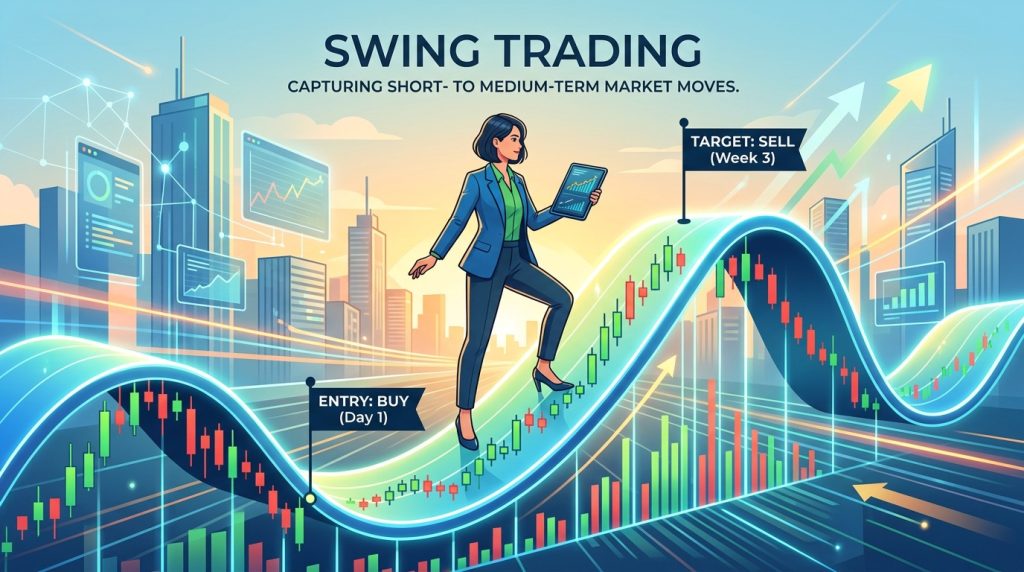
Swing trading is easy to package because it sits in a comfortable middle ground. It does not require the seller to claim impossible long term returns, and it does not require the frantic theater of scalping. The promoter can present themselves as a serious trader who waits for setups, manages risk, and compounds steadily. That image works well on social media because it looks adult. A feed full of calm chart annotations, weekly watchlists, and after the fact “entries” appears more credible than the old boiler room style promise of instant wealth. The scam is often not in the trading language itself. The scam is in what the seller asks you to do next.
That next step is usually one of four things. You are asked to buy signals, join a paid room, copy trades, fund an account with a linked broker, or send money to a supposed account manager who will trade for you. Each path turns educational or market commentary into a revenue model. Sometimes the service is simply poor. Sometimes it is deceptive but not obviously illegal. Sometimes it is a direct fraud from the start. The boundary matters, because bad analysis is not the same as a scam. The trouble is that scam operators work hard to make that boundary blurry. Poor results can always be blamed on market conditions. Fraud can hide inside that excuse for longer than many traders expect.
The sales logic is straightforward. Swing trading promises action without demanding constant screen time. It appeals to working people, newer traders, and frustrated investors who want something more active than passive investing but less exhausting than intraday speculation. Scammers know that. So the pitch is framed around convenience, discipline, and pattern recognition. The seller rarely says “this is easy money” in so many words. Instead they say the setup is high probability, the process is rules based, and the mentor has already done the hard work. That sounds less silly, which is exactly why it sells.
If you want to know more about how swing trading really works and why is a legitimate trading style that is often used for scams then i recommend that you visit the website Swing Trading.
The most common swing trading scam is not always a fake broker. Often it is a fake expert. The account posts charts, trade recaps, and performance screenshots designed to imply a repeatable edge. The audience is then pushed into a subscription, a private Discord or Telegram room, or a “mentorship” program. The real product may be recycled chart commentary, trades posted after the move, or contradictory calls that let the seller later highlight only the winners. This works because retail traders are used to uncertainty. They do not expect every trade to win. So a scammer does not need perfection. They only need just enough selected evidence to keep the room paying.
The SEC recently warned investors not to rely solely on information from group chats for investment decisions, noting that scammers can pose as financial experts or professionals and run stock tip schemes there. That warning fits swing trading rooms very well. The group environment creates false consensus. If enough accounts praise the admin, celebrate wins, or post gains, the service begins to look validated by a community rather than by audited evidence. That is social proof doing most of the heavy lifting. The trading method is often secondary.
A related version is the trading course that exists mainly to upsell. The low priced entry product leads to higher ticket coaching, software, proprietary indicators, funded account “prep,” or access to premium signals. In some cases the education is merely mediocre. In worse cases the entire funnel is built on fabricated results, fake student testimonials, and hidden affiliate arrangements with brokers. The student thinks they are buying skill development. In reality they are being walked through a sales ladder. That does not always qualify as securities fraud in a narrow legal sense, but it can still be deceptive enough to empty an account with depressing efficiency.
Another common scam uses swing trading language to disguise classic manipulation. A group claims to research “breakout” names, momentum names, or catalyst driven swings. In reality, the organizer is front running the group or coordinating a ramp so that followers create the move. FINRA said in December 2025 that it had seen a significant spike in complaints tied to fraudulent investment groups promoted through social media, and it cited an FBI public service announcement noting at least a 300 percent increase in victim complaints referencing ramp and dump stock fraud compared with 2024. That matters because many of these groups do not present themselves as obvious penny stock pumps. They present as disciplined swing trading communities identifying early setups. Same trick, tidier language.
The method is old. The wrapper is newer. Organizers can seed excitement across several channels, use fake success posts, and create urgency around a so called watchlist stock before dumping into the buying pressure they helped manufacture. A trader with some experience may assume they are participating in momentum. Sometimes they are. Sometimes they are the liquidity event. The difference tends to become clear only after the promoter has already sold and the “community” goes quiet or starts explaining why risk management matters all of a sudden. Funny how educational that part becomes.
Swing trading scams also lead directly into fake or abusive broker relationships. A trader joins a room, receives signals, then is told results are best through a specific broker or platform. That platform may be unregistered, offshore, cloned from a real brand, or wholly fake. Sometimes the next step is even worse: the trader is persuaded to hand account access to a supposed manager who will execute swing trades on their behalf. The CFTC has repeatedly warned that investment scams now often begin on social media and move into private chats, where fake experts guide victims toward bogus trading websites and accounts showing fabricated gains. The visible balance rises, withdrawals stall, and extra payments are demanded to release funds. At that point the swing trading story was only the bait. The real business was custody theft.
This is where many traders lose track of the real problem. They argue with the “manager” about strategy or ask whether the latest losing swing setup can be recovered. Those are the wrong questions. Once you no longer control custody and withdrawal, the issue is not poor trading performance. It is counterparty fraud. A fake platform can show gains or losses as needed because the numbers on screen are not proof of real execution. They are part of the script. Regulators keep stressing that fake trading sites can simulate normal account behavior very convincingly. A good interface is not evidence of a genuine market relationship.
The newest layer is synthetic credibility. FINRA warns that fraudsters can use AI to clone voices, alter images, and create fake videos to spread false or misleading information. In practice, that means the swing trading guru may not even be fully real as presented. Testimonials can be manufactured, profit clips can be staged, and video endorsements can be faked well enough to get a viewer through the first step of the funnel. The trader is not just evaluating a dubious analyst anymore. The trader is evaluating media that may itself be partly fabricated.
The SEC has also warned that fraudsters may impersonate the SEC or its staff through social media or text messages to lure investors into scams, including stock tips and fake recovery offers. That is relevant because swing trading communities often lean heavily on authority. If a scam operator can borrow the voice of a regulator, a broker, or a known market commentator, they can compress trust very quickly. Once the target joins a room or funds a linked account, the swing trading content becomes background scenery. The authority signal did the real work.
A trader who knows basic chart structure is not immune. In some ways that knowledge can make the scam easier to sell. The setups shown by the promoter do not need to be absurd. They can be broadly plausible. A pullback entry, a breakout retest, a moving average trend continuation, a catalyst gap with follow through, all of these are familiar enough to feel real. That familiarity lowers the need for proof. The victim thinks, “This could work,” and that thought quietly becomes, “This person probably knows what they are doing.” Those are not the same statement.
Selective evidence does the rest. The scammer posts winners, deletes losers, reframes missed entries, and attributes bad calls to discipline failures by members. In a paid room, members can help the deception along without realizing it. Some genuinely had a good week. Some want to justify the fee they paid. Some fear looking foolish after recruiting friends. The room then starts producing its own propaganda. That is one reason group chat scams work so well. The deception becomes partly self maintaining.
There is also the small win problem. A trader may make money on early signals, especially in a strong market or in a manipulated tape. That does not validate the service. It often deepens the trap. The person upgrades to a more expensive tier, funds a partner broker, or stops doing independent due diligence because the room “already paid for itself.” The distinction between a profitable trade and a trustworthy operation gets lost. That is where basic market knowledge stops helping and starts getting in the way a bit. Success, even accidental success, is persuasive.
A real educator or research service should be boring in the right places. It should be clear about what it is selling, what it is not selling, and what the limitations are. It should not imply verified performance where none exists. It should not require custody of client funds. It should not make withdrawal relevant, because it should not be holding your money in the first place. Those sound like obvious points, but scam funnels blur them constantly by combining education, execution, and account funding in one package. That is where trouble begins.
The payment structure tells you a lot. A research service charging a flat subscription for commentary is different from a service that pressures you into a particular broker, uses affiliate links without clear disclosure, or claims you need managed execution to get the advertised result. Once someone’s revenue depends on where you deposit rather than on whether their analysis stands on its own, interests start to bend. Not automatically into fraud, but often in that direction.
Verification matters more than screenshots. Claimed win rates, account snippets, and testimonial videos are weak evidence in a market environment where fake content is cheap. FINRA’s warning about AI enabled deception is relevant here because the threshold for believable performance theater has fallen. A trader should assume that isolated screenshots and polished videos prove very little. What matters more is whether the seller makes claims that can be independently checked, whether disclosures are consistent, and whether the business model still works if you ignore every glamorous performance claim.
The venue matters too. The SEC’s warning about group chat advice is not saying every trading room is a scam. It is saying that anonymous or semi anonymous chat environments are ideal for stock tip fraud and impersonation. So the more the service depends on urgency, private access, insider tone, and community pressure, the less comfort a trader should draw from activity inside the room itself. Busy chat is not due diligence. It is just busy chat.
Then there is the simple custody test. If a swing trading service ever ends with you sending money to an unverified platform, giving account access to a “manager,” or being told your funds are locked pending a fee or tax payment, you are no longer evaluating a trading educator. You are inside a fraud pattern already described by U.S. regulators across social media and fake investment platform warnings. Stop thinking in terms of setups and start thinking in terms of evidence preservation and reporting.
If you already paid for a service, joined a room, or funded a linked platform, the first task is to stop additional payments and preserve records. Save chats, invoices, screenshots, email headers, payment receipts, platform URLs, wallet addresses, phone numbers, and promotional material. The FTC advises people to slow down, research company names with terms like review, scam, fraud, or complaint, and report fraud through official channels. If the setup involved a fake trading platform or social media investment group, those records matter because the operator may delete channels, rename accounts, or claim the room was only “educational.”
Do not trust recovery offers from strangers, especially if they claim to be regulators, lawyers, or specialists who can unlock the account for a fee. The SEC has warned that impersonators use social media and text messages for fake recovery schemes. That is often the second scam after the first loss. The swing trading room may disappear, and a new hero turns up offering rescue for one more payment. Same fraud economy, new costume.
Swing trading scams work because they borrow the language of ordinary market activity. The setups sound plausible, the time frame sounds reasonable, and the seller often looks more disciplined than the old stereotype of an investment scammer. That is exactly why the category deserves caution. The fraud is rarely in the phrase “swing trading.” It is in the fake authority, the manipulated community, the hidden incentives, or the platform that should never have had your money in the first place. A familiar strategy can still be the wrapper for a very ordinary theft.