Introduction
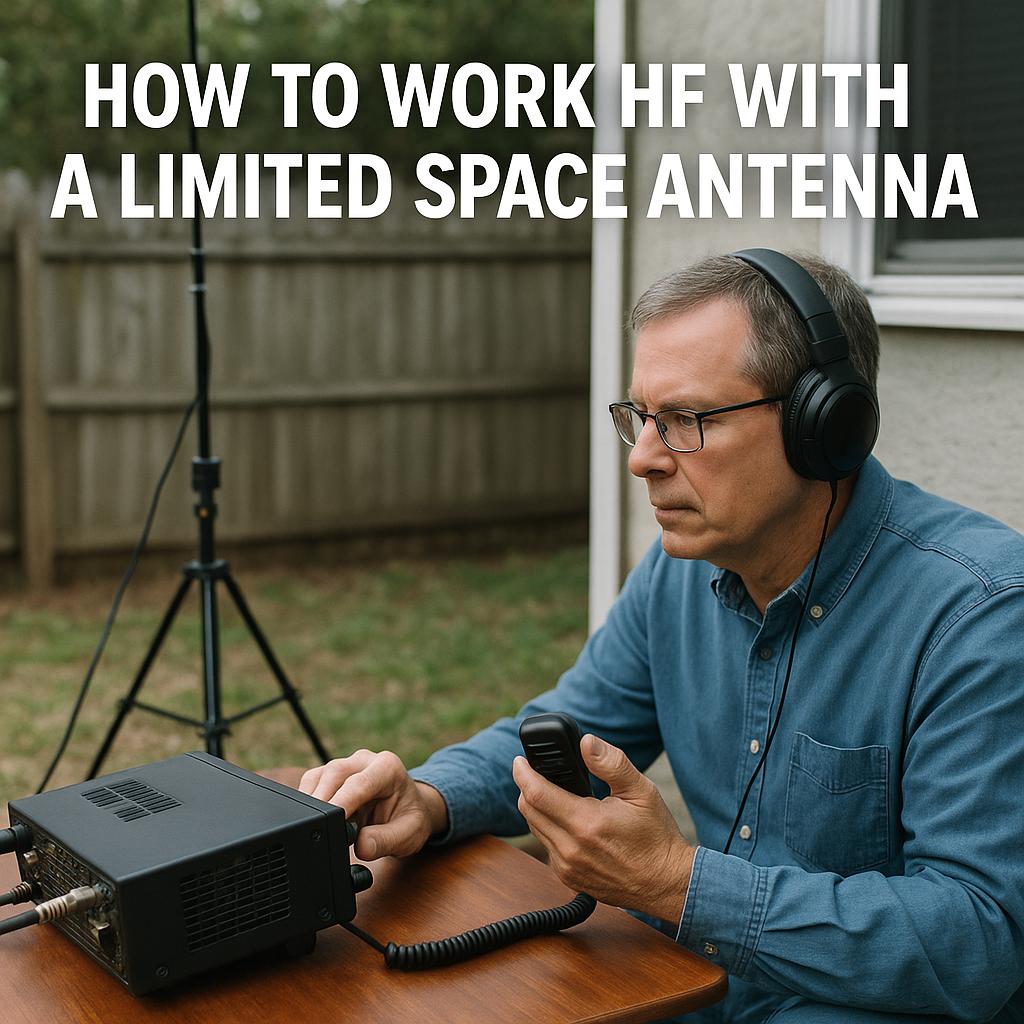
Working HF (High Frequency) with limited space often poses a challenge for amateur radio enthusiasts. However, with creative solutions and an understanding of some basic concepts, it is possible to achieve effective communications within tight spatial constraints.
Understanding HF Antennas
HF antennas are designed to transmit and receive signals in the high-frequency bands, typically ranging from 3 to 30 MHz. The size of an antenna is usually related to the wavelength it can effectively operate on. For HF bands, this often means larger antennas, which can be problematic for those with limited space.
Types of Antennas Suitable for Limited Spaces
Limited space does not mean limited options. Several antenna types are suitable for compact environments. Let’s explore these options in more detail to understand how they can be employed effectively.
Vertical Antennas: These antennas utilize their height to compensate for the lack of horizontal space. They can be installed in smaller areas such as backyards, rooftops, or even balconies, and are effective for omnidirectional communication. The vertical nature allows them to have a smaller footprint, which is ideal for urban areas. Typically, the performance of vertical antennas is enhanced by using a good ground system or radials that can help with efficiency.
Dipole Antennas: A shortened dipole can be deployed in limited spaces by either bending or folding the antenna elements to fit the area available. Another approach is to use a multi-band dipole, which can cover several bands within a single structure. The advantage of dipole antennas is their simplicity and effectiveness. They can be mounted in various configurations such as inverted V, sloper, or even positioned in an L-shape to conserve space. These configurations help make the most of the space available while maintaining reasonable performance characteristics.
End-Fed Antennas: These are popular for their flexibility and ease of installation. End-fed antennas are long and narrow, making them ideal for covert installations or when running along property lines or fences. They are often chosen for their capability to support multiple bands. Having an end-fed configuration can be advantageous because it only requires a single point of installation, usually at or near one of the property boundaries. This point can be easily matched with an appropriate impedance matching device or tuner if needed.
Note: Some configurations require an antenna tuner to ensure proper impedance matching, especially if the antenna dimensions do not closely align with the wavelength for the desired frequency. An antenna tuner is a valuable piece of equipment that can help you achieve the best possible match between the antenna and the radio, reducing potential losses and maximizing power transfer.
Using Stealth and Mobile Antennas
In situations where antenna installations must be discreet due to restrictive covenants or aesthetic considerations, both stealth and mobile antennas provide viable alternatives.
Stealth Antennas: These are designed to be inconspicuous, often blending into surroundings or taking unusual shapes. Options include using wire concealed within other structures or utilizing camouflaged paint schemes. You might consider creating an antenna that doubles as a flagpole or one that is integrated into the architecture of a building, like railing or window trim. Stealth antennas work well in communities with strict regulations, encouraging experimentation and creativity.
Mobile Antennas: Car antennas can double as effective home solutions. By mounting them on metal structures or grounding systems, these antennas can serve well in stationary but limited installations. The portability of mobile antennas provides flexibility; they can be detached and reconfigured easily as needed. Converting a vehicle-mounted antenna for stationary use involves ensuring it is adequately grounded and supported to optimize its operational capability for HF transmissions.
Practical Installation Tips
To ensure you get the best performance from your limited space antenna setup, consider the following practical installation tips.
– Use high-quality coaxial cable to reduce loss and maintain signal integrity. High-frequency signals are susceptible to loss, and a low-quality cable can dramatically affect performance. Prioritize quality to protect your signal from attenuation.
– Ensure all connections are weatherproof and secured to prevent moisture ingress. This can be achieved by using weatherproof tape or sealants for external connectors.
– Experiment with antenna orientation and height for optimal performance. Altering the orientation can impact the directionality and coverage of your signal, while adjusting the height can affect the overall range and contact potential.
– Regularly check the SWR (Standing Wave Ratio) to ensure efficient operation. Evaluating the SWR ensures that the antenna is matched to the transmitter, allowing for the best possible power transfer and reducing reflected power, which can damage equipment over time.
Conclusion
With thoughtful planning and a bit of experimentation, working HF on limited space can be both satisfying and effective. By choosing the right antenna and optimizing your setup, high-frequency communications are well within reach no matter the spatial limitations. Whether utilizing a compact vertical, dipole, or end-fed antenna, or perhaps experimenting with stealth or mobile solutions, amateur radio enthusiasts can navigate physical constraints to continue enjoying this rewarding pastime. Understanding basic principles of antenna operation and being willing to adapt can lead to successful radio communications, ensuring that spatial limitations do not equate to reduced capabilities. Experimentation is key, along with maintaining a proactive approach to understanding the dynamic environment in which these antennas operate, to achieve optimal performance and communication satisfaction.